- Reverse ATS is a candidate-side system that applies ATS-style deterministic filtering to job postings instead of to CVs: maintained lists of criteria, a weekly sourcing cycle, and a shortlist that only precise matches survive.
- LinkedIn sourcing breaks down into five structural problems: discovering new target companies, monitoring their openings, no company-level exclusion, no filter for personal hard stops, and timing – applying within the first 24–48 hours raises response rates.
- Two filters reward precision over volume: ATS screening before a human reads the CV, then a ~7-second recruiter scan. Sourcing quality, not application quantity, is the lever.
- About 65% of active job-search time goes to these repetitive, rule-based tasks before a single CV is tailored.
- The weekly cycle has five steps; the four sourcing and filtering steps are automatable, CV tailoring stays manual by design. At least 74% of active LinkedIn employers have their own careers page, so career-page monitoring replaces LinkedIn search as the primary source.
Main Logic
LinkedIn is the biggest database of open job positions. There are several ways to find a position to apply to: pick target companies and monitor openings, search manually by location and role, follow LinkedIn recommendations, or read posts in the feed.
In practice, these tasks are treated as inherently manual – "just be active on LinkedIn, and the rest will follow." This piece looks at why that assumption is expensive, and what can be automated.
Problem Statement
The manual process breaks down into five distinct structural problems:
- Target Company Awareness Problem. You have a list of target companies, but new relevant companies appear constantly and there is no systematic way to discover them.
- Target Position Awareness Problem. Monitoring a large list of companies for new openings requires significant, repetitive manual effort.
- Negative Company Filtering Problem. LinkedIn lets you exclude individual job postings but not entire companies. Companies you know are not a fit must be manually skipped every session.
- Hard Stop Criteria Filtering Problem. A hard stop is a personal disqualifier that rules a posting out however well it otherwise fits – a language requirement, an industry, a recent round of layoffs. LinkedIn has no native filter for them, so they are applied by hand every time.
- Timing Problem. For competitive roles, applying within the first 24–48 hours meaningfully increases response rates. Manual processes make this hard to sustain.
The current application funnel compounds these problems: most companies use ATS systems that filter CVs before any human sees them (filter 1), and recruiters spend an average of ~7 seconds on initial CV review (filter 2). Both filters reward precision over volume, which makes sourcing quality – not application quantity – the real lever. Based on observed weekly job search cycles, these five problems account for approximately 65% of total job search time before a single CV is tailored. See the full breakdown →
The Task: Partial Automation
Initial Setup
The system requires four input lists:
- Company_fit_criteria_list – the criteria that define a good-fit company (stage, industry, culture signals, etc.)
- Companies_to_watch_list – companies that have passed fit criteria and are actively monitored
- Companies_to_skip_list – companies reviewed and disqualified, with a reason recorded (eliminates FOMO and keeps fit criteria sharp)
- Hard_stop_list – absolute disqualifiers: language requirements, specific role constraints, layoff history, etc.
- Position_description_list – target role keywords and seniority criteria
The watch and skip lists are maintained in parallel deliberately. Knowing a company is not a fit is as valuable as knowing one is – it eliminates re-evaluation on future encounters and sharpens the criteria over time. All lists are live and updated continuously.
The Cycle
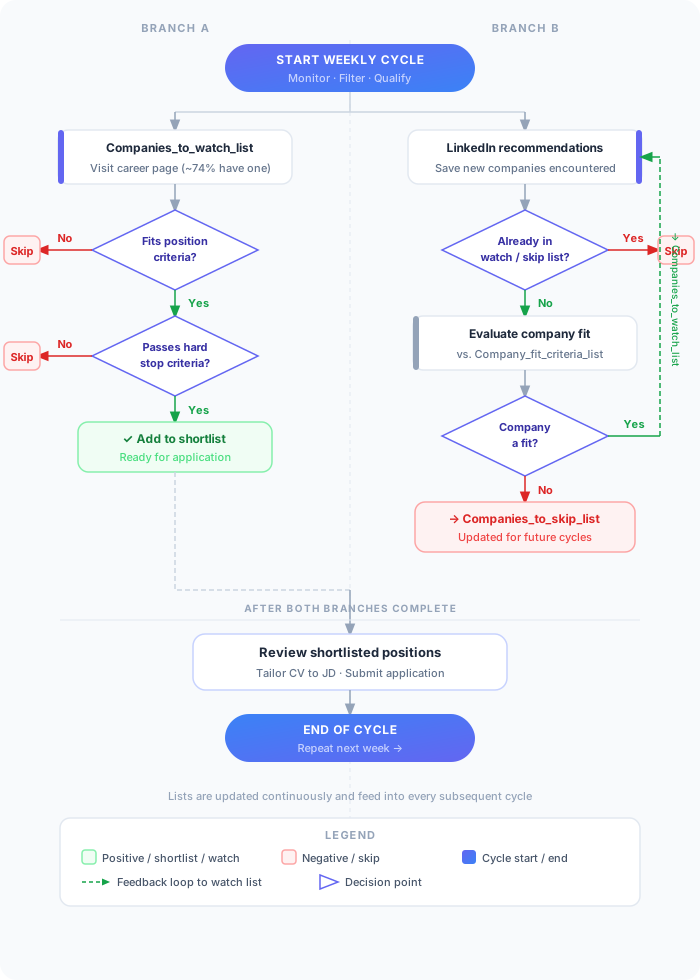
A sourcing cycle is one weekly pass through the watch list: every company's careers page checked, new postings collected and filtered against the criteria, and only precise matches kept. The watch list is the set of companies whose careers pages are checked on that pass, each kept with its career-page URL, alongside a skip list of companies deliberately excluded. Once the lists are in place, the cycle runs as follows:
- Go through Companies_to_watch_list → check each company's careers page (at least 74% of active LinkedIn employers have one – see the probability breakdown)
- For any new positions: check against Position_description_list, then against Hard_stop_list. If both pass → add to shortlist for application
- Review new LinkedIn recommendations → save new companies encountered
- For each new company not yet on either list: evaluate against Company_fit_criteria_list → update watch or skip list accordingly
- Tailor CV for shortlisted roles → apply
Steps 1–4 are fully automatable. Step 5 – tailoring the CV – benefits from human judgment and remains manual by design.
The Cycle Diagram
The process flow for the semi-automated sourcing cycle (v0.1):
Where This Leaves Us
The five problems above are not random inconveniences. They are structural properties of how LinkedIn works: a platform optimised for engagement, not for precision sourcing.
The case for partial automation rests on a simple observation: ~65% of active job search time is spent on tasks that are repetitive, rule-based, and produce no direct output. Running through a watch list, cross-referencing hard stop criteria, and verifying whether a role is still active are all deterministic operations – the same logic applied over and over to new inputs. These are exactly the conditions under which automation delivers the most value.
The two steps that remain manual – discovering new companies from LinkedIn and tailoring the CV for each role – are genuinely hard to automate well. The first may conflict with LinkedIn ToS; the second requires language and context that benefit from human input. These are the steps where time is best spent.
The architecture for this semi-automated cycle (v0.1) is currently in development.